A good dash cam should record what happens when you’re driving.
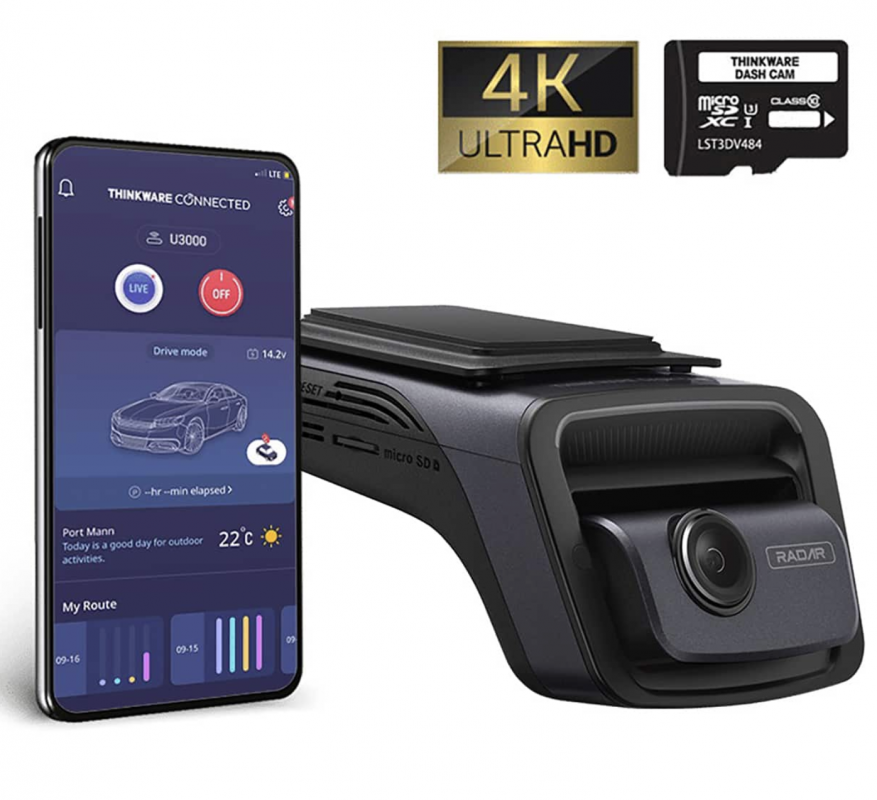
THINKWARE U3000 4K
A great dash cam should also protect your car when you’re not driving.
That’s the idea behind the Thinkware U3000.
At first glance, the U3000 looks like another premium 4K dash cam. It has a Sony STARVIS 2 front sensor, a 2K rear camera, GPS, Wi-Fi, voice guidance and all the usual safety features you’d expect from a high-end model.
But its biggest selling point isn’t actually the 4K video.
It’s the built-in radar parking mode.
Instead of keeping the cameras running continuously while your car is parked, the U3000 can use low-power radar sensors to monitor movement around the vehicle and wake the camera when something approaches.
That makes it particularly interesting for people who regularly park their car outdoors, on the street or in busy parking lots.
But there’s a catch.
The U3000 is expensive, and its video quality isn’t necessarily class-leading in every situation. The original U3000 also lacks HDR, while the rear camera uses an older STARVIS 1 sensor.
So, after looking at its features, real-world feedback and independent testing, is the Thinkware U3000 actually worth the premium?
Thinkware U3000: Our Verdict
Rating: 8.5/10
The Thinkware U3000 is one of the most feature-rich premium dash cams available, but it’s a camera with a very specific strength.
Parking protection.
The integrated radar system is genuinely useful. It allows the U3000 to monitor your vehicle while consuming considerably less power than conventional motion-detection parking modes.
That can make a huge difference if your car spends long periods parked.
The front camera also produces very good daytime footage, thanks to its Sony STARVIS 2 IMX678 sensor and 4K resolution. GPS, Wi-Fi, voice guidance and Thinkware’s parking features make it feel like a premium product.
However, there are reasons not to buy it.
The U3000 is expensive.
Its rear camera is based on the older Sony STARVIS 1 IMX335 sensor, and the original U3000 does not have HDR. This can become noticeable in difficult nighttime lighting, particularly when headlights are shining directly towards the camera.
The smartphone experience is also not as polished as some competitors.
In other words:
The U3000 is not necessarily the best dash cam for everyone.
But if your priority is protecting your car while it is parked, it becomes much easier to justify.
Pros
- Excellent 4K daytime footage
- Sony STARVIS 2 IMX678 front sensor
- Built-in radar for parking surveillance
- Radar works at the front and rear
- Very low-power parking mode
- 2K rear camera
- GPS built in
- Wi-Fi connectivity
- Voice guidance
- Good build quality
- Supercapacitor instead of a conventional battery
- Smart high-temperature parking protection
- Optional cloud connectivity
- OBD-II power option makes installation easier
- 64GB microSD card included with many bundles
Cons
- Expensive compared with many competitors
- Original U3000 lacks HDR
- Rear camera uses an older STARVIS 1 sensor
- Night footage isn’t class-leading
- Smartphone app could be more polished
- Some settings can be confusing
- Full parking functionality requires additional power installation
- Optional cloud/LTE functionality adds cost
- No display on the camera
THINKWARE U3000 4K
What Is the Thinkware U3000?
The Thinkware U3000 is a premium front-and-rear 4K dash cam system designed for drivers who want both high-quality driving footage and advanced parking surveillance.
The front camera records at 4K UHD, while the rear camera records at 2K.
The front sensor is Sony’s STARVIS 2 IMX678, while the rear uses the older STARVIS 1 IMX335.
The front camera has a 158-degree field of view and the rear camera has a 128-degree field of view.
Unlike many dash cams, the U3000 doesn’t have a screen.
Instead, Thinkware expects you to configure and review the camera through its smartphone software and voice guidance.
That isn’t necessarily a disadvantage.
In fact, the screenless design helps keep the camera relatively discreet.
But it does mean you’ll rely heavily on the app when you want to change settings or review footage.
4K Front Camera
The U3000’s main camera uses the Sony STARVIS 2 IMX678 sensor.
This is one of the reasons the camera performs so well during the day.
At 4K resolution, there’s plenty of detail in the footage, making it possible to identify road signs, vehicles and license plates at reasonable distances.
Independent testing generally agrees that daytime footage is one of the U3000’s strengths.
DashCamTalk rates its daytime video at 9/10, while PCWorld also described the captures as good.
The 158-degree field of view is wide enough to capture plenty of the road without making the image excessively distorted.
For normal daytime driving, there’s very little to complain about.
But There’s an Important Problem With the Night Video
This is where things get more complicated.
The original U3000 does not have HDR.
That’s particularly relevant when driving at night.
If a vehicle approaches you with bright headlights, the difference between the extremely bright lights and the dark road can be difficult for the camera to handle.
Independent testers have specifically criticised the lack of HDR and reported problems with license plates being blown out when illuminated by headlights.
This doesn’t mean that the U3000 has bad night vision.
It doesn’t.
The Sony STARVIS 2 sensor performs well in low light and the camera can still produce useful nighttime footage.
But at this price, you might reasonably expect the camera to be excellent in every lighting condition.
It isn’t.
This is one of the most important things to understand before buying.
The Rear Camera Is Good, But Not as Impressive
The rear camera records at 2K.
That’s plenty for most situations and represents a significant improvement over the 1080p rear cameras found on cheaper systems.
However, it uses Sony’s older IMX335 STARVIS 1 sensor rather than the newer STARVIS 2 technology used in the front camera.
That creates a noticeable difference between the two cameras.
The front camera is clearly the star of the system.
The rear camera is good.
It’s just not at the same level.
PCWorld found the daytime rear footage slightly overexposed but still detailed, while nighttime rear footage was described as quite good overall.
The Real Reason to Buy the U3000: Radar Parking Mode
This is where the U3000 becomes genuinely different.
Most dash cams use one of two approaches to parking surveillance.
They either:
- Keep the camera running and monitor for movement, or
- Put the camera into a low-power mode and wake it when an impact occurs.
The U3000 adds a third option.
Radar.
The U3000 contains radar sensors that can monitor movement around the vehicle while the camera is in a very low-power state.
When the radar detects movement within its detection range, the camera wakes up and records.
Thinkware says its radar parking mode uses low-power front and rear radar sensors and records a 20-second clip when movement is detected.
This is a clever solution to a real problem.
A camera that is constantly processing video consumes considerably more power than one sitting in an ultra-low-power state.
The radar allows the U3000 to remain alert without continuously operating the cameras at full power.
Why Radar Parking Mode Matters
Imagine leaving your car parked overnight.
A conventional motion-detection dash cam might need to keep the camera and processor active continuously.
That consumes power.
The U3000 can instead monitor its surroundings using radar and wake the cameras when necessary.
That’s particularly useful if you:
- Park on the street
- Leave your car in public parking lots
- Regularly park overnight
- Own a vehicle with a relatively small battery
- Want long-term parking surveillance
- Are concerned about hit-and-runs
- Want evidence if somebody approaches or damages your car
Independent testing has shown just how significant the power savings can be.
BlackboxMyCar measured the U3000’s energy-saving parking mode at more than 20 days for a dual-channel setup under its test conditions.
Obviously, real-world results will vary depending on temperature, battery condition, settings and how frequently the camera wakes up.
But the underlying idea is extremely impressive.
The Radar Isn’t Perfect
This is another area where it’s worth being realistic.
Radar isn’t magic.
Its detection range is relatively narrow, and independent testers have found that its behaviour doesn’t always perfectly match the way the documentation suggests it should work.
One detailed DashCamTalk test found that radar-triggered recording sometimes behaved more like energy-saving parking mode than the expected buffered radar mode.
The radar also doesn’t replace the camera.
It simply decides when the camera should wake up.
So if you are buying the U3000 because you expect radar to create a perfect 360-degree security system around your vehicle, you’ll be disappointed.
It’s better to think of it as:
an extremely efficient motion detector for your dash cam.
And at that job, it’s very good.
Parking Mode Requires Additional Power
There’s another important consideration.
The U3000 cannot provide its full parking surveillance capabilities from a normal cigarette-lighter connection once you turn the car off.
Thinkware requires either a hardwire installation or an OBD-II power cable for parking mode.
Fortunately, the OBD-II option makes installation considerably easier for many vehicles.
You simply connect the cable to the vehicle’s OBD-II port rather than accessing the fuse box.
That’s one reason some owners describe the installation as surprisingly easy.
A recent owner review on Thinkware’s site praised the OBD installation and described the image quality and general setup as excellent.
Smart Parking Mode
Thinkware has also included temperature protection.
Cars can become extremely hot when parked in direct sunlight.
Running a 4K dash cam inside a hot vehicle for hours isn’t ideal.
The U3000’s Smart Parking Mode can switch to a lower-power recording mode if the temperature becomes too high or too low.
It then prioritizes impact detection until conditions return to normal.
This is an important feature for anyone living in a hot climate.
It also demonstrates that Thinkware has designed the U3000 as a camera intended to remain in the vehicle permanently rather than simply being used occasionally.
Supercapacitor Instead of a Battery
The U3000 uses a supercapacitor rather than a conventional lithium-ion battery.
That’s a sensible decision for a device that spends its life inside a car.
A car interior can reach extremely high temperatures, particularly in summer.
Supercapacitors are generally better suited to this environment than conventional rechargeable batteries.
The U3000’s supercapacitor provides enough energy for the camera to safely finish writing its final recording after the vehicle is switched off.
It isn’t designed to keep the camera recording after the power is disconnected.
That’s not its purpose.
What About the Thinkware App?
This is probably the U3000’s weakest area outside of its price.
The hardware is excellent.
The software is more mixed.
The U3000 uses Thinkware’s smartphone ecosystem to configure the camera, view footage and manage settings.
Bluetooth makes the initial connection easier than some older Thinkware cameras, and recent owner feedback suggests the connection experience is better than the previous U1000 generation.
But the overall app experience isn’t universally praised.
Some users find the interface more complicated than competing dash cam apps.
There are also settings that aren’t immediately obvious.
This isn’t a dealbreaker.
Once configured, most people won’t spend much time inside the app.
But if you frequently want to download footage, change settings or use live view, the experience isn’t quite as polished as the best smartphone-first dash cams.
Wi-Fi and Video Downloads
The U3000 includes Wi-Fi for connecting to your smartphone.
This allows you to access recordings without physically removing the microSD card.
That’s useful after an incident.
Instead of taking the card out, finding a computer and searching through folders, you can connect your phone and retrieve the relevant recording.
However, Wi-Fi isn’t the fastest or most seamless implementation we’ve seen.
Some independent testing has found limitations during live viewing, and one test reported that the front recording resolution temporarily dropped while live view was active.
Again, it’s not a dealbreaker.
But it is another example of the U3000 having excellent hardware paired with software that isn’t quite as refined.
GPS and Safety Features
GPS is built into the U3000.
This allows the camera to associate recordings with location and speed information.
The camera also offers a range of driver-assistance features, including warnings related to lane departure and forward collisions.
These can be useful for some drivers.
However, we’d recommend treating them as additional features rather than the reason to buy the camera.
Modern cars already include increasingly sophisticated driver-assistance systems.
The U3000’s core strengths remain:
Video recording + parking surveillance.
Cloud Connectivity
Thinkware also offers cloud-connected functionality for compatible setups.
With the appropriate configuration, the system can provide features such as vehicle location, impact notifications and geofencing.
This can be particularly useful for people who want to know what’s happening with their vehicle remotely.
However, cloud connectivity adds complexity and, depending on the setup, additional hardware or connectivity requirements.
For most private drivers, it’s an optional extra rather than an essential feature.
What Do Owners Say?
The owner feedback is generally positive, but not universally enthusiastic.
Thinkware’s own U3000 front-and-rear product page currently shows a 4.7/5 rating from 64 reviews, with the large majority giving the camera five stars.
The positive feedback tends to focus on exactly the areas you’d expect:
- Image quality
- Easy installation
- Build quality
- Parking protection
- Reliability
- The convenience of the OBD cable
One recent owner specifically praised the 4K front and 2K rear video, easy installation and the OBD connection.
Other users have highlighted the camera’s ability to provide evidence after accidents.
There’s also positive feedback from owners who have previously used other dash cams and were impressed with the U3000’s overall build and image quality.
But there is a recurring theme among negative and more critical feedback:
The U3000 is expensive.
And once you’re paying premium money, expectations become much higher.
The Biggest Problem: Price
This is probably the easiest criticism to understand.
The U3000 is expensive.
At its original launch price, the dual-channel version was around $550 in the US. PCWorld considered that a significant weakness, describing the camera as expensive despite its excellent feature set.
And that’s before considering additional accessories.
Depending on your vehicle and how you want to use the camera, you may want:
- OBD-II cable
- Hardwire kit
- External battery
- Cloud connectivity
- LTE-related accessories
Suddenly, the total cost can become substantially higher than the headline price.
That’s why the U3000 makes much more sense when discounted.
At a good sale price, it’s easier to recommend.
At full retail price, you should compare it very carefully with alternatives.
Thinkware U3000 vs VIOFO A229 Pro
This is one of the most interesting comparisons.
The VIOFO A229 Pro is often cheaper while offering excellent video quality.
The VIOFO also offers a 3-channel configuration, depending on the model.
So why buy the Thinkware?
The answer is:
Parking mode.
The U3000’s radar system is something VIOFO doesn’t replicate in the same way.
If you park your car outside for long periods, the Thinkware has a major advantage.
If you mostly care about driving footage and want maximum value for your money, the VIOFO may make more sense.
That’s why there isn’t a universally “better” camera here.
They’re designed around different priorities.
Thinkware U3000 vs VIOFO A329S
The A329S is another serious competitor.
The VIOFO puts a much stronger emphasis on image quality, high-resolution recording and fast connectivity.
The Thinkware counters with its sophisticated parking system and broader vehicle-protection features.
So again:
Driving footage: A329S has a strong argument.
Parking surveillance: U3000 has the advantage.
Value: A329S is likely to be easier to justify.
Parking-focused ownership: U3000 becomes much more interesting.
Who Should Buy the Thinkware U3000?
We think the U3000 makes the most sense for:
- Drivers who regularly park outside
- People worried about hit-and-runs
- Drivers who leave their vehicle unattended for long periods
- People who want long-duration parking surveillance
- Owners who want premium build quality
- Drivers who want excellent daytime 4K footage
- People who prefer an OBD-II installation
- Drivers willing to pay more for advanced parking features
Who Shouldn’t Buy It?
The U3000 probably isn’t the right choice if:
- You’re on a tight budget
- You mainly care about driving video
- You want the best possible night performance
- You want HDR on the original model
- You want a modern, extremely polished smartphone app
- You don’t use parking mode
- You want 4K on both front and rear cameras
- You’re looking for the best price-to-performance ratio
In those situations, there are cheaper alternatives that may actually be a better purchase.
THINKWARE U3000 4K
Thinkware U3000 Specifications
| Feature | Thinkware U3000 |
|---|---|
| Front resolution | 4K UHD |
| Front sensor | Sony STARVIS 2 IMX678 |
| Front FOV | 158° |
| Rear resolution | 2K QHD |
| Rear sensor | Sony STARVIS IMX335 |
| Rear FOV | 128° |
| GPS | Yes |
| Wi-Fi | Yes |
| Radar | Front + rear |
| Parking mode | Yes |
| Smart parking | Yes |
| Supercapacitor | Yes |
| Display | No |
| Voice guidance | Yes |
| Cloud | Optional |
| OBD-II power | Supported |
| Hardwire | Supported |
| microSD | Included depending on package |
Thinkware U3000 Ratings
Video quality: ⭐⭐⭐⭐½ 9/10
Daytime video: ⭐⭐⭐⭐⭐ 9.5/10
Nighttime video: ⭐⭐⭐⭐ 7.5/10
Parking mode: ⭐⭐⭐⭐⭐ 10/10
Build quality: ⭐⭐⭐⭐⭐ 9.5/10
Features: ⭐⭐⭐⭐⭐ 9.5/10
App: ⭐⭐⭐½ 7/10
Ease of installation: ⭐⭐⭐⭐½ 9/10
Value for money: ⭐⭐⭐½ 7/10
Overall: ⭐⭐⭐⭐½ 8.5/10
Final Verdict
The Thinkware U3000 is an excellent dash cam.
But it isn’t excellent because it has the highest resolution or the most impressive specification sheet.
It’s excellent because Thinkware has paid particular attention to something many dash cam manufacturers treat as an afterthought:
what happens when your car is parked.
The built-in radar parking system is the U3000’s killer feature.
It allows the camera to monitor the vehicle using very little power and wake up when movement is detected.
For somebody who parks on the street every night, that can be far more valuable than an extra few megapixels.
The 4K front camera is also very good during the day, the 2K rear camera provides useful coverage, the build quality is excellent and the supercapacitor design makes sense for a device living inside a hot car.
But there are compromises.
The original U3000 doesn’t have HDR.
The rear camera uses an older sensor.
Nighttime performance isn’t unbeatable.
The app could be better.
And, most importantly, the camera is expensive.
That last point is crucial.
If you don’t need advanced parking surveillance, there are cheaper cameras that offer better value.
But if you regularly leave your vehicle parked outside and want one of the most sophisticated low-power parking systems available, the Thinkware U3000 is one of the strongest options you can buy.
Our verdict: Highly recommended for parking protection, but only at the right price.
Frequently Asked Questions
Is the Thinkware U3000 worth buying?
Yes, particularly if parking surveillance is important to you. Its radar-based parking mode is one of its biggest advantages. If you only want high-quality driving footage, cheaper alternatives may offer better value.
Does the Thinkware U3000 record in 4K?
Yes. The front camera records in 4K UHD. The rear camera records in 2K.
Does the Thinkware U3000 have HDR?
The original U3000 does not have HDR. This is one of its main weaknesses compared with newer premium dash cams.
Does the Thinkware U3000 have Sony STARVIS 2?
Yes. The front camera uses the Sony STARVIS 2 IMX678 sensor. The rear camera uses the older STARVIS IMX335.
Does the Thinkware U3000 have parking mode?
Yes. Parking surveillance is one of the camera’s main selling points. It includes radar parking mode, impact detection and other parking recording options.
Does radar parking mode drain the car battery?
Radar parking mode is specifically designed to use very little power. Actual parking duration depends on the vehicle battery, temperature, settings and how often the camera is triggered.
Does the Thinkware U3000 need to be hardwired?
Not necessarily. Thinkware supports an OBD-II power cable, which can provide a simpler installation on compatible vehicles. Full parking functionality requires an appropriate constant-power installation.
Does the Thinkware U3000 have a screen?
No. The U3000 is a screenless dash cam. Configuration and footage review are handled through the smartphone app.
Does the Thinkware U3000 have GPS?
Yes, GPS is built into the U3000.
Is the Thinkware U3000 good at night?
It’s good, but not perfect. The STARVIS 2 front sensor performs well in low light, but the original U3000 lacks HDR, which can make bright headlights and high-contrast nighttime scenes difficult.
Is the Thinkware U3000 better than the VIOFO A229 Pro?
It depends on what you value. The U3000’s major advantage is its radar-based parking system. The VIOFO A229 Pro is a very strong alternative if driving video quality and value are more important than advanced parking surveillance.
Our Bottom Line
The Thinkware U3000 is not the dash cam we’d recommend to everyone.
But for the right driver, it may be one of the best.
If your car spends most of its life parked outdoors and you’re worried about hit-and-runs, vandalism or unexplained damage, the U3000’s radar parking system is genuinely useful.
If you simply want the best 4K dash cam for the lowest price, look elsewhere.
Buy it for the parking protection. Stay for the excellent 4K footage.