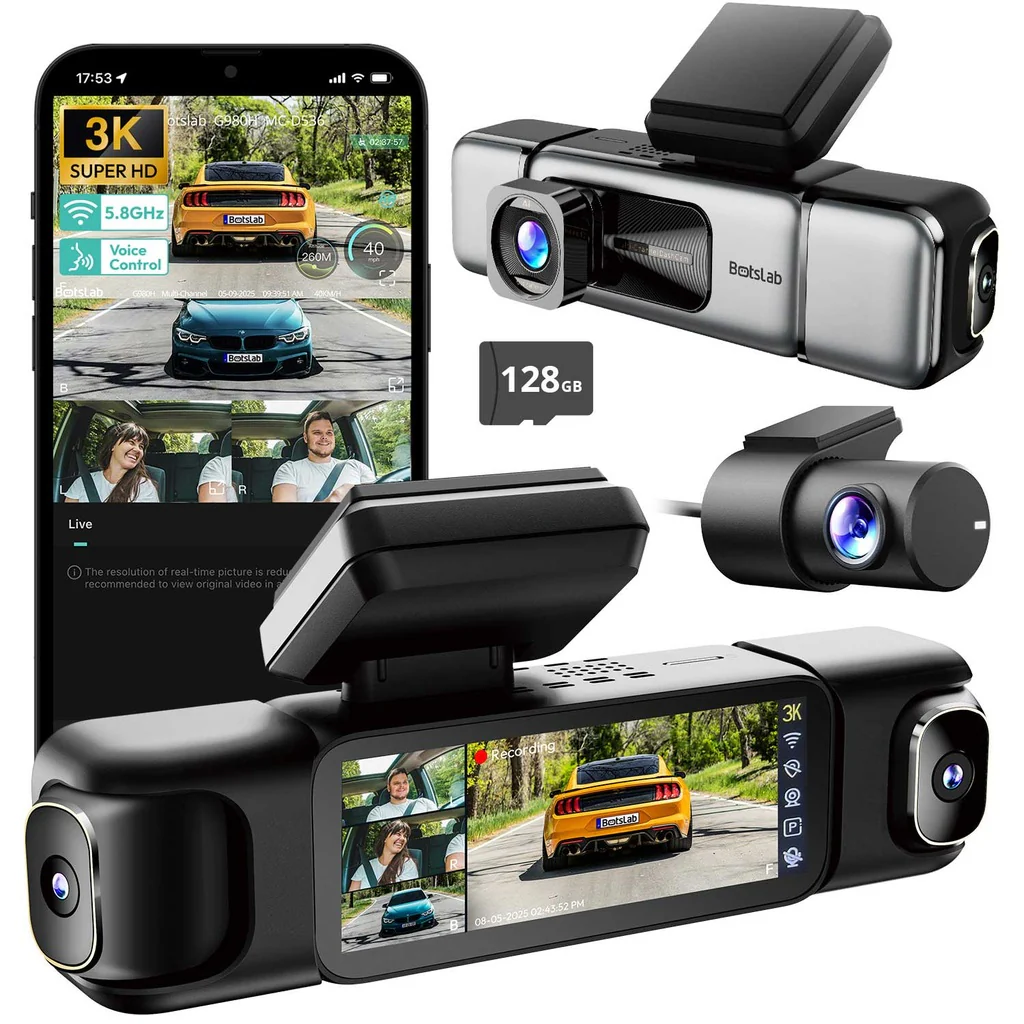
Botslab G980H 4CH
Most dash cams are designed to record what’s happening in front of you.
Some add a rear camera.
A few go one step further and add an interior camera.
But what if you want to see what is happening on both sides of your vehicle as well?
That’s where the Botslab G980H 4CH takes a very different approach.
Instead of simply offering front and rear recording, the G980H 4CH uses four cameras covering the front, rear, left and right sides of the vehicle.
The result is a dash cam system designed to provide almost complete coverage around your car.
And that’s its biggest selling point.
But there’s a catch.
The G980H isn’t necessarily the best dash cam if your number-one priority is the highest possible image quality at night. Independent testing has found that the additional cameras are much more limited in low-light conditions than the main camera.
So, is the Botslab G980H 4CH actually worth buying?
We’ve looked at its specifications, user feedback and independent testing to find out.
Botslab G980H 4CH: Our Verdict
Rating: 8/10
The Botslab G980H 4CH is an unusual dash cam, and that’s precisely what makes it interesting.
Its biggest advantage is coverage.
With front, rear, left and right cameras, the G980H can capture things that conventional front-and-rear dash cams simply won’t see.
A car approaching from the side.
A collision while changing lanes.
Someone opening their door into your vehicle.
An encounter at the side of the road.
An incident involving a cyclist or pedestrian beside your vehicle.
That’s the reason to buy this camera.
The main front camera provides good daytime video, while the side cameras can be adjusted to record either outside the vehicle or inside the cabin. The magnetic mounting system also makes them surprisingly flexible. (CKTechCheck)
However, the G980H 4CH isn’t perfect.
The rear and side cameras are only 1080p, and independent testing has found that their nighttime performance is considerably weaker than the main camera. The front camera also lacks HDR, which can be a significant disadvantage in difficult lighting conditions. (DashCamTalk)
So our recommendation is simple:
Buy the G980H 4CH for its coverage, not because it has the best low-light image quality.
Pros
- Four-channel recording
- Front, rear and both sides covered
- Excellent coverage around the vehicle
- Adjustable magnetic side cameras
- 3K front camera
- 1080p rear and side cameras
- 170° front field of view
- 120° side cameras
- 150° rear camera
- 3.18-inch touchscreen
- Built-in GPS
- 5.8GHz Wi-Fi
- Voice control
- 24/7 parking mode with hardwire kit
- 128GB card included
- Supports up to 512GB
- Supercapacitor
- Easy magnetic installation
Cons
- Side and rear cameras are only 1080p
- Nighttime performance isn’t its strongest point
- Front camera lacks HDR
- Parking motion detection has limitations
- Side cameras may not trigger parking recordings in some scenarios
- App translation can feel awkward
- Some advertised AI features feel unnecessary
- Hardwire kit is required for full parking protection
What Is the Botslab G980H 4CH?
The Botslab G980H 4CH is a four-channel dash camera system designed to record four different directions simultaneously.
The cameras cover:
Front: 3K video with a 170° field of view.
Rear: 1080p video with a 150° field of view.
Left: 1080p video with a 120° field of view.
Right: 1080p video with a 120° field of view.
Botslab describes the system as providing 560° of combined coverage, although that number should be understood as the sum of the individual camera viewing angles rather than literally seeing 560 degrees of space simultaneously. (Botslab)
The important thing is that you get something most conventional dash cams don’t provide:
side coverage.
And that’s potentially extremely useful.
Botslab G980H 4CH Specifications
| Feature | Botslab G980H 4CH |
|---|---|
| Cameras | 4 |
| Front | 3K |
| Rear | 1080p |
| Left | 1080p |
| Right | 1080p |
| Front field of view | 170° |
| Side field of view | 120° each |
| Rear field of view | 150° |
| Display | 3.18-inch touchscreen |
| GPS | Yes |
| Wi-Fi | 5.8GHz |
| Voice control | Yes |
| Parking mode | Yes |
| Parking hardwire | Required |
| Included memory card | 128GB |
| Maximum storage | Up to 512GB |
| Power | Supercapacitor |
| Installation | Magnetic / tool-free |
The official specifications confirm the 3K + 1080p × 3 configuration for the four-channel version. (Botslab)
Four Cameras Instead of Two
This is where the G980H becomes interesting.
Most dash cams concentrate on what’s happening in front of you.
A typical two-channel system adds a rear camera.
That’s enough for many drivers.
But there are situations where the most important part of an incident happens beside your vehicle.
Imagine you’re changing lanes and another vehicle hits you from the side.
Your front camera might capture the other vehicle approaching.
Your rear camera might show what happened afterwards.
But neither camera necessarily provides a clear view of the actual point of contact.
The G980H’s side cameras are designed specifically to fill that gap.
And this is something owners seem to appreciate.
Botslab’s own customer reviews include users praising the overall coverage and the ability to rotate the side cameras to record either the side windows or the cabin. (Botslab)
The 3K Front Camera
The main camera records at up to 3K resolution.
It’s not the highest resolution available in the dash cam market, and it’s important not to confuse this particular 4CH configuration with the 4K versions of the G980H.
The official 4CH specification is 3K + 1080p + 1080p + 1080p. (Botslab)
During daylight, the front camera produces good footage and is capable of capturing useful detail.
That makes it suitable for the primary job of a dash cam:
documenting what happens on the road.
However, independent testing has highlighted an important weakness.
The front camera does not have HDR, which can make difficult lighting conditions more challenging.
Botslab G980H 4CH
How Good Is the G980H at Night?
This is probably the biggest weakness of the G980H 4CH.
During daylight, the system’s four cameras are genuinely useful.
At night, things become more complicated.
Independent testing found that the main camera struggles more than expected in low-light conditions and that the side and rear cameras lose considerable image quality at night. (DashCamTalk)
This doesn’t mean that the G980H is useless at night.
It means you need to understand what you’re buying.
If your priority is:
“I want the best possible license-plate capture at night.”
There are better choices.
If your priority is:
“I want to know what happened around my entire vehicle.”
The G980H becomes much more attractive.
That’s an important distinction.
The Side Cameras Are the Real Reason to Buy It
The two side cameras are arguably the most interesting part of the entire system.
They’re mounted magnetically and can be adjusted to change what they see.
You can position them to monitor the side of the vehicle or angle them towards the interior.
This makes the system surprisingly versatile.
For example, a rideshare driver could potentially configure the cameras to provide additional cabin coverage.
A private driver could point them towards the side windows.
Someone concerned about side impacts could position them to maximize coverage alongside the vehicle.
The modular design is one of the aspects that users seem to particularly like. (MobileSyrup)
Rear Camera
The rear camera records at 1080p.
This is perfectly adequate for general rear coverage, but it’s not going to compete with the 2K or 4K rear cameras found on more premium dual-channel systems.
That’s another example of the G980H’s philosophy.
Botslab has sacrificed some resolution in exchange for more cameras and more coverage.
If you compare it directly with a premium front-and-rear dash cam, the rear image quality may be disappointing.
But that’s not really what this camera is trying to do.
360-Degree Coverage: Does It Really Work?
Yes — with an important qualification.
The G980H doesn’t literally produce one continuous 360-degree panoramic image.
Instead, it uses four separate cameras positioned around the vehicle.
That gives you substantially more coverage than a conventional dash cam.
The official configuration is:
170° front + 120° left + 120° right + 150° rear. (Botslab)
The benefit is obvious.
You aren’t relying on one camera with a very wide lens to see everything.
You have dedicated cameras watching different areas.
For documenting incidents, this can be a major advantage.
Parking Mode
The G980H supports several parking surveillance modes, including:
- Sentry mode
- Collision detection
- Time-lapse recording
However, there is an important condition:
You’ll need the hardwire kit for full 24/7 parking protection. (Botslab)
Time-lapse recording can be particularly useful because it reduces storage requirements while keeping an eye on your vehicle.
The camera can also record impact events using its G-sensor.
However, independent testing uncovered some limitations.
The motion detection system primarily relies on the front camera, meaning the side cameras don’t necessarily provide the same level of parking-event detection.
That’s something we’d definitely consider before buying the G980H specifically for parking surveillance. (DashCamTalk)
GPS and Wi-Fi
The G980H includes built-in GPS and Wi-Fi.
The GPS can associate recordings with location information and can be used with the company’s software and app.
The Wi-Fi connection is particularly useful when you need to transfer footage to your phone.
Botslab advertises a 5.8GHz Wi-Fi connection, designed to make transferring large video files considerably faster. (Botslab)
This is a welcome feature.
Four cameras generate a lot of footage.
Downloading video through a slow wireless connection would quickly become frustrating.
3.18-Inch Touchscreen
The G980H uses a 3.18-inch touchscreen.
That’s larger than the tiny displays found on many compact dash cams.
The touchscreen makes it easier to configure the camera and switch between different views.
You can also use voice commands for functions such as taking photos or displaying the rear camera. (Botslab)
The physical design is also relatively discreet considering that this is a four-camera system.
Voice Control
Voice control is another useful convenience feature.
You can use voice commands for certain functions without reaching for the camera.
It’s not a reason by itself to buy the G980H, but it’s a nice addition.
And when you’re driving, being able to control the camera without touching it is preferable to navigating menus on a touchscreen.
Driver Fatigue Alerts
Botslab also includes a driver fatigue alert feature.
The camera can provide a voice reminder after extended driving.
It’s an interesting safety feature, although we wouldn’t buy the G980H specifically for it.
The core value of this camera remains its multi-camera coverage.
The additional AI and driver-assistance features should be considered bonuses rather than deciding factors.
Botslab G980H 4CH
What Do Owners Say About the Botslab G980H?
The owner feedback is generally quite positive.
Botslab’s own website currently shows a 4.8/5 rating from 137 reviews, with 85% of reviewers giving five stars. (Botslab)
Several reviews specifically praise the coverage.
One owner described the four-channel system as providing excellent overall coverage and said the ability to adjust the side cameras was particularly useful.
Another owner praised the design, saying the camera remained relatively hidden in the vehicle while still providing impressive image and audio quality.
There are also positive comments about customer support.
One owner reported that a camera joint broke but said Botslab’s customer service arranged a replacement. (Botslab)
Independent reviewers have also found the system easy to use.
A recent MobileSyrup review praised the modular design, ease of installation and the ability to transfer footage using the app. The reviewer also liked the peace of mind provided by the system’s extensive coverage. (MobileSyrup)
But there are criticisms too.
The Problems With the G980H
The biggest criticism is nighttime image quality.
This is especially important because some marketing materials can make the camera sound more capable than it really is.
Independent testing found that the lack of HDR is a significant weakness and that the additional cameras don’t perform particularly well in darkness. (DashCamTalk)
The second issue is the app.
While the app generally works and makes transferring footage relatively easy, some users and reviewers have commented on awkward English translations and an interface that isn’t as polished as the best dash cam apps.
MobileSyrup specifically noted some awkward English phrasing in the app. (MobileSyrup)
There are also several AI-related features.
Some users may find things such as human recognition and intelligent notifications useful.
Others may simply consider them unnecessary.
The good news is that these features are optional.
G980H 4CH vs a Traditional 2CH Dash Cam
This is the most important comparison to make.
Suppose you have $200–$300 to spend.
Should you buy the G980H 4CH or a premium front-and-rear dash cam?
It depends entirely on what you want.
A premium 2CH system may give you:
- Better front video
- Better rear video
- Better night performance
- Better license-plate capture
- Simpler installation
The G980H gives you:
- Front coverage
- Rear coverage
- Left coverage
- Right coverage
- More complete incident documentation
- More flexible camera positioning
So there’s a very simple way of thinking about it:
2CH = better image quality
G980H 4CH = more coverage
That’s the fundamental trade-off.
Who Should Buy the Botslab G980H 4CH?
We think the G980H makes the most sense for:
- Drivers who want maximum coverage
- People concerned about side collisions
- Rideshare drivers
- Taxi drivers
- Drivers who frequently carry passengers
- Drivers who want to monitor the sides of their vehicle
- People who want a four-camera system without spending a fortune
- Drivers who prioritize coverage over absolute image quality
Who Shouldn’t Buy It?
We would look elsewhere if your priorities are:
- The best possible nighttime video
- Maximum license-plate readability
- 4K recording from every camera
- Premium rear-camera quality
- The best smartphone app
- A simple front-and-rear installation
- The absolute best image quality for the money
If those are your priorities, a high-end VIOFO, BlackVue or Vantrue system may be a better choice.
Is the Botslab G980H 4CH Worth It?
Yes — but only if you understand why you’re buying it.
The G980H isn’t trying to beat premium dash cams in every category.
Instead, it solves a very specific problem:
How can you record what’s happening around your entire vehicle without installing four completely independent cameras?
And it solves that problem surprisingly well.
The side cameras are genuinely useful.
The magnetic mounts make the system flexible.
The front camera provides good daytime footage.
The touchscreen is convenient.
GPS and Wi-Fi are useful.
Parking mode adds another layer of protection.
And having four separate views can be extremely valuable when something happens from the side.
But if you’re expecting four cameras producing premium-quality footage at night, you’ll probably be disappointed.
Our Rating
Coverage: ⭐⭐⭐⭐⭐ 10/10
Daytime video: ⭐⭐⭐⭐½ 8.5/10
Nighttime video: ⭐⭐⭐ 6/10
Front camera: ⭐⭐⭐⭐ 8/10
Rear camera: ⭐⭐⭐½ 7/10
Side cameras: ⭐⭐⭐⭐ 8/10
Features: ⭐⭐⭐⭐½ 9/10
Parking mode: ⭐⭐⭐⭐ 8/10
Ease of installation: ⭐⭐⭐⭐½ 9/10
App: ⭐⭐⭐½ 7/10
Value for money: ⭐⭐⭐⭐½ 9/10
Overall: 8/10
Final Verdict
The Botslab G980H 4CH is one of the more interesting dash cams we’ve seen because it doesn’t simply try to compete with conventional 4K front-and-rear cameras.
It takes a different approach.
It gives you more eyes.
The four-camera setup provides coverage around the front, rear and sides of your vehicle, which can be extremely valuable when documenting an accident or another incident.
That’s particularly important because not every accident happens directly in front of your car.
Sometimes the most important evidence is beside you.
The G980H can capture that.
Its biggest weakness is nighttime image quality, particularly from the side and rear cameras. The lack of HDR on the main camera is also disappointing for a modern dash cam.
But if you prioritize complete coverage over absolute image quality, the G980H 4CH becomes a very compelling proposition.
For drivers who want a conventional front-and-rear dash cam with the best possible image quality, we’d look elsewhere.
For drivers who want front + rear + left + right coverage, the Botslab G980H 4CH is definitely worth considering.
Our verdict: Recommended for coverage-focused drivers.
Frequently Asked Questions
Is the Botslab G980H 4CH really 4K?
Not in the four-channel configuration.
The G980H 4CH records 3K from the front camera and 1080p from the rear and two side cameras. Botslab also sells other G980H configurations that support 4K front recording, which can cause some confusion when comparing specifications. (Botslab)
Does the Botslab G980H record the sides of the car?
Yes. The 4CH version has dedicated left and right cameras, each with a 120° field of view.
Does the Botslab G980H have a rear camera?
Yes. The 4CH version includes a 1080p rear camera with a 150° field of view.
Does the Botslab G980H have parking mode?
Yes. It supports Sentry, collision and time-lapse parking modes. A hardwire kit is required for full 24/7 parking protection. (Botslab)
Does the Botslab G980H have GPS?
Yes. GPS is built into the camera.
Does the Botslab G980H have Wi-Fi?
Yes. The G980H supports 5.8GHz Wi-Fi for transferring footage to your phone. (Botslab)
Does the Botslab G980H work at night?
Yes, but nighttime performance is one of its weaker areas. Independent testing has found that the side and rear cameras perform considerably worse in low-light conditions than the main camera. (DashCamTalk)
Is the Botslab G980H good for Uber and Lyft drivers?
It can be a good choice for rideshare drivers because the four-camera configuration provides extensive coverage around the vehicle, while the adjustable side cameras can also be positioned to monitor the cabin.
Is the Botslab G980H 4CH worth buying?
If your priority is maximum coverage around the vehicle, yes. If your priority is the best possible nighttime image quality and license-plate capture, there are better alternatives.